You catch your reflection after washing your face, in light that hides nothing. The temples look hollower than you remember. There is a shadow under the cheekbone, the under-eye area looks sunken, and the jawline has softened into the neck. You have not been ill and your weight has barely moved. The face simply looks less full, and less like yours.
That is facial volume loss. It is common by the mid-forties and often starts earlier. Knowing which layer is changing tells you what can help, from skincare at home to treatments such as Sculptra.
The short answer
Facial volume loss happens in four layers at once. The fat compartments deflate and descend, the facial skeleton remodels so the platform under the soft tissue moves back, the retaining ligaments loosen, and the skin thins. Good skincare improves the top layer. It cannot replace volume lost underneath. Where that volume has gone, the options are to place it, with hyaluronic acid filler, or to grow it, with a collagen stimulator such as Sculptra.
What changes beneath the surface
Fat compartments deflate and slide
The face’s fat sits in separate compartments rather than one sheet, mapped by Rohrich and Pessa in 2007, and they age at different rates. Some deflate and some descend, so you get hollowing above and heaviness below: hollow temples and upper cheeks, deeper folds and jowls lower down. Much of the fat has not vanished. It has moved.
The facial skeleton remodels
Bone is living tissue. CT studies by Shaw and colleagues found that with age the angles of the midface decrease and the eye sockets widen. The shelf holding the soft tissue forward moves back, so the same fat projects less and the under-eye area looks more hollow. This is a change in shape, measured as angles and apertures, not a simple loss of bone density.
Ligaments loosen
Retaining ligaments anchor skin and fat to the bone. As they slacken, tissue they once held starts to slide, which is why volume loss and sagging so often arrive together. It matters for treatment: lost volume can be rebuilt, but tissue that has descended may need lifting rather than filling.
Skin thins
Collagen and elastin give skin its thickness and recoil. Production falls with age and sunlight breaks collagen down faster, so skin drapes rather than holds and shows every change underneath. This is the only layer of the four that skincare can reach, and it is the thinnest.
These changes compound. Deflated fat sits on a receding platform, held by looser ligaments, under thinner skin. Treating one layer alone often disappoints, which is why assessment matters more than any single product. If the change is mostly in your mid-face, why cheeks look hollow covers that area in more detail.

Why some faces change faster
Weight loss is the accelerator I see most. Rapid loss from any cause takes fat from the face early, because the face has little in reserve. Many patients I see with fast hollowing are taking semaglutide or tirzepatide, but there is no controlled evidence that these drugs target facial fat. The likelier explanation is the speed of loss. What happens to the skin is covered in skin laxity after weight loss.
Sun and smoking act on the skin rather than the fat. Ultraviolet light breaks down collagen and smoking narrows the small vessels that feed the dermis. Neither removes volume, but both thin the covering, so existing loss shows more.
Build matters too. A lean face with fine bone structure has less cushioning to begin with, so a small loss reads as a large one. Bone shape and fat distribution vary between people and run in families, so some faces show these changes years later than others.
If any of this sounds familiar, a skin assessment is the right starting point. There is no obligation and no assumption about treatment.
What you can do at home
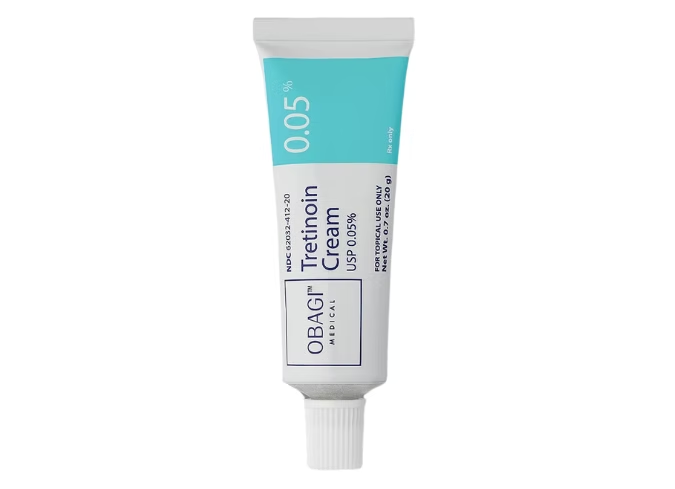
A prescription retinoid
Topical retinoids have the best evidence of anything you can apply for photoageing. A 2025 meta-analysis of eight randomised trials covering 1,361 patients found tretinoin improved both fine and coarse wrinkles compared with a placebo base. The effect is real and modest: it improves skin quality, not volume. Tretinoin is a prescription-only medicine in the UK, so the strength and routine are decided at a consultation, which is what our prescription retinoid skin programme is for.
Daily SPF
Broad-spectrum sunscreen every day is the most useful preventive step, because ultraviolet damage to collagen builds up year on year. It will not reverse loss that has already happened. It slows what comes next.
An antioxidant serum
A vitamin C serum in the morning, under sunscreen, adds protection against ultraviolet and pollution damage. It supports the routine; it is not a treatment.
Enough protein, especially when losing weight
Protein supports collagen production and protects lean tissue during weight loss. General adult guidance sits around 1.2 to 1.6 grams per kilogram a day, a sensible baseline from nutrition research rather than a proven facial treatment.
The limit of home care
Everything above works on the skin. Descended fat, a remodelled skeleton and loose ligaments all sit beneath it. Once volume has gone from underneath, skincare is working on the wrong layer.
How Sculptra restores volume
Sculptra is poly-L-lactic acid. Unlike hyaluronic acid filler, it adds almost nothing on the day. The particles prompt fibroblasts to lay down new collagen over the following weeks, which Goldberg and colleagues confirmed on biopsy, and the poly-L-lactic acid is then broken down by the body. The volume that remains is your own tissue.
A course is usually two or three sessions, four to six weeks apart. Change starts to show at six to eight weeks and builds over three to six months. In the pivotal trial, results lasted up to 25 months after the last session in some patients, so around two years is a ceiling rather than a promise. Sculptra cannot be dissolved, which is why I dose conservatively and build in stages.
It suits diffuse volume loss across the temples, cheeks and jawline, in people happy to wait. It is the wrong tool if you want a change for an event next month, if your main concern is sagging rather than lost volume, or if you want the option to reverse it. Then cheek filler, threads or skin tightening may suit you better. Course planning, prices and what to expect are on the Sculptra treatment in London page.
Placing volume or growing it
| Hyaluronic acid filler | Sculptra | |
|---|---|---|
| How volume arrives | Placed | Grown from your own collagen |
| Visible | Same day | From 6 to 8 weeks, building over 3 to 6 months |
| Typical duration | Months to around two years, depending on product and area | Up to around two years in some patients |
| Reversible | Yes, with hyaluronidase | No |
| Best for | Precise definition, or trying volume for the first time | Broad, diffuse loss across the face |
Key takeaways
- Facial volume loss happens in four layers: fat, bone, ligaments and skin.
- Fast weight loss, sun, smoking and a lean build bring it forward.
- A prescription retinoid and daily SPF improve skin quality but cannot rebuild lost volume.
- Filler places volume on the day and can be reversed; Sculptra grows it over months and cannot.
Next steps
If you recognise these changes, arrange a skin assessment at Hampstead Aesthetics, 269 West End Lane, West Hampstead. We will work out which layers are doing most of the work in your face and what is realistic, including whether doing nothing is the sensible answer for now.
Frequently asked questions
What causes facial volume loss?
Four changes together: fat compartments deflate and descend, the facial skeleton remodels, retaining ligaments loosen and the skin thins. Age drives all four. Rapid weight loss, sun exposure, smoking and a lean build bring them forward.
At what age does facial volume loss start?
The changes begin quietly from the thirties, and most people notice them between their late thirties and fifties. When yours shows depends on build, sun history, smoking and weight change as much as on age.
Can you reverse facial volume loss naturally?
Not the volume itself. A prescription retinoid, daily SPF and good nutrition improve skin quality and slow further damage, but nothing applied to the skin can rebuild deflated fat or a remodelled skeleton. That needs filler, a collagen stimulator or, where tissue has descended, a lift.
Does weight loss make facial volume loss worse?
Often, yes. The face has a small fat reserve and gives it up early, especially with fast weight loss. Losing weight more slowly gives the skin more time to adapt, though it does not prevent the loss.
Where does the face lose volume first?
Usually the temples, upper cheeks and under-eye area, then around the mouth and along the jawline. The order varies with build, which is why two people of the same age can look very different.
Is Sculptra or filler better for facial volume loss?
Neither is better; they do different jobs. Filler places volume precisely on the day and can be dissolved. Sculptra grows broad volume over months, lasts longer and cannot be dissolved. Many faces do best with both, and the Sculptra page explains how the two are combined.
Sources
- Rohrich RJ, Pessa JE. The fat compartments of the face. Plast Reconstr Surg 2007;119(7):2219–2227
- Shaw RB Jr, Katzel EB, Koltz PF, et al. Aging of the facial skeleton. Plast Reconstr Surg 2011;127(1):374–383
- Huang HY, Lee LTJ. Tretinoin for photodamaged facial skin: systematic review and meta-analysis. Dermatol Pract Concept 2025;15(4):a5172
- Goldberg D, Guana A, Volk A, Daro-Kaftan E. Tissue response to injectable poly-L-lactic acid. Dermatol Surg 2013;39(6):915–922
- Narins RS, Baumann L, Brandt FS, et al. Poly-L-lactic acid for nasolabial fold correction. J Am Acad Dermatol 2010;62(3):448–462
The Goldberg and Narins studies were funded by the manufacturer of Sculptra, as declared in the papers.
Disclaimer
This article is general information and not a substitute for a medical consultation. Sculptra and dermal fillers are offered at Hampstead Aesthetics, so read it as an explanation from a clinic that provides these treatments. Outcomes vary between individuals.