Laser Hair Removal in West Hampstead, London
Laser hair removal is permanent reduction, not permanent removal, and the difference between a good result and a burn is the wavelength chosen for your skin. I explain both before anyone is treated.


Laser hair removal uses a pulse of light absorbed by the melanin in the hair shaft, which heats the follicle enough to disable it while the surrounding skin is cooled and spared. Only hairs in their growing phase are vulnerable, so a course of six to eight sessions, four to six weeks apart, is needed to catch each follicle in turn; after that, most patients have a permanent reduction of the large majority of hair in the treated area, with a maintenance session every six to twelve months for the regrowth that hormones drive. The clinic’s laser combines three wavelengths, alexandrite at 755 nanometres for lighter skin and fine hair, diode at 810 for most skin and coarse hair, and Nd:YAG at 1064, which passes through the pigment of darker skin and treats skin types V and VI safely. It works on dark hair and not on white, grey or true blonde hair, which have no melanin to absorb the light, and it is a medical procedure with a medical assessment, because the same energy that disables a follicle will burn or pigment skin if the wrong wavelength is chosen.
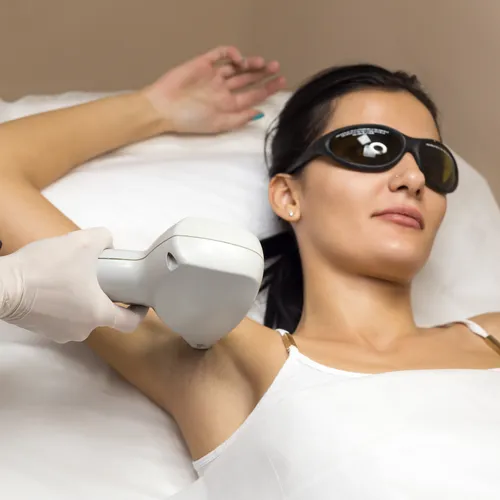
⭐⭐⭐⭐⭐ 4.8 / 5
202 Google reviews
GMC
Registered Doctor
MRCS
Royal College of Surgeons
All skin types
I to VI
ABOUT LASER HAIR REMOVAL
How laser hair removal works, and why it takes a course
The principle is selective photothermolysis: a wavelength of light chosen to be absorbed by one target, the melanin in the hair, delivered in a pulse short enough to heat that target before the heat spreads to the tissue around it. The hair shaft conducts the heat down to the bulb and the stem cells in the bulge of the follicle, and at sufficient temperature those cells are destroyed and the follicle cannot regrow a hair. Skin contains melanin too, which is why the skin is cooled before, during and after each pulse and why the wavelength is chosen to favour the hair over the skin: the longer the wavelength, the less it is absorbed by the epidermis and the deeper it reaches, which is why 1064 nanometres is the wavelength for darker skin.
Hair grows in cycles. At any moment only a proportion of the follicles in an area, around a fifth on the body and up to two-thirds on the face, are in the anagen, or growing, phase, with the hair connected to the bulb and the stem cells active; the rest are resting or shedding and are not affected by the laser. Each session disables the follicles that are in anagen that day, and the next session, four to six weeks later on the face and six to eight on the body, catches the next group. That is why a course is six to eight sessions and why a single session reduces hair by only a fraction.
What laser hair removal does not do: it does not remove every hair permanently, because some follicles survive and hormones recruit new ones, so the honest term is permanent reduction with maintenance; it does not work on white, grey, red or true blonde hair, which lack the pigment the light needs; and it does not treat hair driven by an untreated hormonal condition without that condition being addressed, which as a GP I look for. Where hair growth is new, coarse and in a male pattern in a woman, a blood test for polycystic ovary syndrome and other causes comes before a course.
AREAS I TREAT
From the upper lip to the full body
Any area with dark hair can be treated. The wavelength and settings are chosen for the skin type and the hair in each area.
Face: upper lip, chin, sideburns, full face
The commonest areas in women, often hormonal; four to six weeks apart. Chin and lip take minutes.
Underarms, bikini and Brazilian
The most satisfying areas for most patients; coarse hair responds fastest.
Legs, arms and back
Larger areas, six to eight weeks apart; the back and chest for men.
Neck and beard shaping for men
Ingrown hairs and shaving rash resolve when the follicle is disabled; a common reason men come.
THE TREATMENT
What happens at the consultation and the session
The consultation takes 20 minutes. I assess your skin type on the Fitzpatrick scale and the colour and coarseness of the hair, ask about sun exposure, tanning, medications that sensitise the skin to light, a history of cold sores, keloid scarring or pigmentation after injury, and, for women with new or coarse facial or body hair, the menstrual and hormonal history that might point to a cause worth testing for. I choose the wavelength and settings and perform a test patch, which is read at 24 to 48 hours in darker skin before any full treatment.
Before a session, shave the area within 24 hours and do not wax, pluck or thread for four weeks, because the laser needs the hair in the follicle to conduct the heat. In the room, the skin is cleansed, protective eyewear is worn, and the handpiece is passed over the area, cooling the skin and firing pulses that feel like a warm flick of an elastic band; coarse hair and the bikini line sting more, the legs less. An upper lip takes five minutes, a full leg thirty, a full body about ninety. The skin is cooled and protected with SPF afterwards.
Sessions are four to six weeks apart on the face and six to eight on the body, for six to eight sessions, then maintenance at six to twelve months. Ingrown hairs, shaving rash and the pigmentation they leave improve alongside; where post-inflammatory marks remain, peels and the prescription retinoid programme clear them. Hair that is white or grey is removed by electrolysis, which I can refer for.
“Laser hair removal is safe in every skin type when the wavelength is right for the skin and dangerous when it is wrong. I assess the skin, test patch it, and choose 1064 nanometres for darker skin without exception. And I say permanent reduction, not permanent removal, because that is what the treatment does.”
Dr Chiké Emeagi, MRCGP, GMC 4418489
LASER COMPARED
Laser against the alternatives, and wavelength against skin type
The first rows compare methods; the later rows explain which wavelength I use for which skin. The realistic-result column is what I say in the room.
| Option | Best for | How it works | When you see it | Course | Realistic result |
|---|---|---|---|---|---|
|
Laser, 755 nm alexandrite |
Skin types I to III with fine or medium dark hair |
Strongly absorbed by melanin; shallow; fast |
After 2 to 3 sessions |
6 to 8 |
The most effective wavelength on fine hair in fair skin; unsafe in darker skin |
|
Laser, 810 nm diode |
Skin types I to IV with medium to coarse hair; most patients |
Balanced absorption and depth |
After 2 to 3 sessions |
6 to 8 |
The workhorse; reliable reduction across most skin and hair |
|
Laser, 1064 nm Nd:YAG |
Skin types V and VI, tanned skin, coarse hair |
Passes through epidermal melanin; reaches deep follicles |
After 3 to 4 sessions |
8 |
The only safe wavelength for dark skin; slightly more sessions |
|
IPL (intense pulsed light) for hair |
Fair skin, dark hair |
Broad-spectrum light filtered to a range |
After 3 to 4 sessions |
8 to 10 |
Less selective than laser; not used on darker skin; not what the clinic uses for hair |
|
Home IPL devices |
Fair skin, dark hair, patience |
Low-energy pulsed light |
Months |
Weekly, ongoing |
Some reduction with consistent use; a fraction of clinic energy; unsafe in dark skin |
|
Electrolysis |
White, grey, red or blonde hair; small areas |
A probe destroys each follicle individually |
Immediately per hair |
Many sessions |
The only permanent method for unpigmented hair; slow |
|
Waxing and threading |
Anyone not wanting a course |
Pulls the hair out |
Immediately |
Every 3 to 6 weeks, forever |
No reduction; ingrown hairs and pigmentation in darker skin |
|
Shaving |
Everyone, between sessions |
Cuts the hair at the surface |
Immediately |
Daily |
What you do during a laser course; it does not make hair coarser |
|
Treating a hormonal cause |
Women with new, coarse, male-pattern hair |
Blood tests; management of the condition |
Months |
As required |
Laser works better and lasts longer once the driver is treated |
The blog posts on how many sessions you really need, laser hair removal for dark skin and whether laser hair removal is permanent answer the three questions I am asked most.
COURSES AND COMBINATIONS
Courses by area, and the spacing
Courses of six are priced below single sessions. Most patients need six to eight, then maintenance.
| Plan | For whom | Spacing | Cost |
|---|---|---|---|
|
Upper lip or chin, course of 6 |
Facial hair; often hormonal |
Every 4 to 6 weeks |
£250 |
|
Full face, course of 6 |
Sideburns, lip, chin and jaw together |
Every 4 to 6 weeks |
£500 |
|
Underarms, course of 6 |
The fastest-responding area |
Every 6 weeks |
£400 |
|
Brazilian, course of 6 |
Coarse hair; responds well |
Every 6 weeks |
£600 |
|
Half leg, course of 6 |
Lower legs |
Every 6 to 8 weeks |
£600 |
|
Full leg, or back, or chest, course of 6 |
Large areas |
Every 6 to 8 weeks |
£900 |
|
Full body excluding face, course of 6 |
Everything at once; 90 minutes a session |
Every 6 to 8 weeks |
£1,750 |
|
Maintenance session |
After a course; hormonal regrowth |
Every 6 to 12 months |
Single-session price for the area |
Costs are from the clinic price list. Two or more areas in one visit are quoted at consultation.
RESULTS
Results and what to expect
After the first session, treated hairs shed over one to three weeks, which looks like growth and is the opposite. After two or three sessions, regrowth is visibly sparser and finer, and shaving drops from daily to weekly. By six sessions most patients have lost the large majority of hair in the area, and what regrows is fine and pale. Ingrown hairs and shaving rash resolve as the follicles are disabled, which for many men and for women with darker skin is the main benefit.
The honest expectations: permanent reduction of most hair, not removal of all of it; maintenance sessions every six to twelve months, more often on the face where hormones drive regrowth; no effect on white, grey or blonde hair; slightly more sessions in darker skin, where the safe wavelength is less strongly absorbed; and a result that depends on not tanning during the course. What a well-treated patient can expect is an area that no longer needs thought, and a treatment they wish they had started sooner.
I photograph treated areas before the course and at the sixth session, and record the settings of every session so the next one builds on it.

Underarms, six sessions
810 nm diode. Photographed 6 weeks after the sixth.
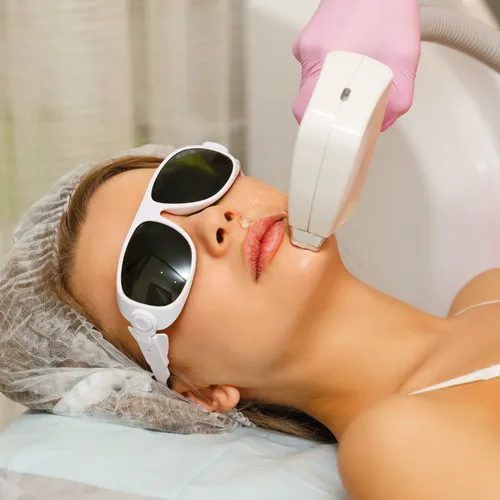
Beard shaping and ingrown hairs, skin type V
1064 nm Nd:YAG, six sessions. Photographed at 8 months.
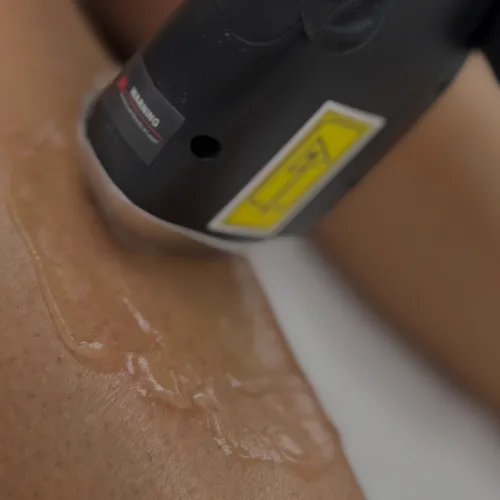
Upper lip and chin, eight sessions
Hormonal hair, 810 nm. Photographed 3 months after the eighth.
AFTER THE SESSION
Recovery, side effects and aftercare
Immediately after. Redness and small bumps around the follicles, like goosebumps, for a few hours to a day; the area feels warm. Cool compresses and aloe help. No make-up on treated facial skin for the rest of the day.
The first week. Treated hairs shed. No sun exposure, sunbeds, self-tan, hot baths, saunas or exercise that heats the area for 48 hours; SPF 50 on any exposed area throughout the course. No waxing, plucking or threading between sessions; shaving is fine.
What to report. Blistering, crusting, or darkening or lightening of the skin, which are the signs of too much energy for the skin type and are rare with correct wavelength choice and a test patch; all have my direct number and are treated early.
Laser is not done on tanned skin, over tattoos, on skin with active infection or cold sores, within six months of isotretinoin, on light-sensitising medicines, or in pregnancy as a precaution.
IS THIS FOR ME?
Is laser hair removal right for you?
The hair has to be dark. Beyond that, the wavelength is chosen for the skin, and almost everyone is suitable.
A good candidate
Dark hair in any skin type, including types V and VI on 1064 nm. Ingrown hairs, shaving rash or pigmentation from hair removal. Anyone tired of waxing or shaving an area. Willing to shave rather than wax between sessions and to avoid sun on the area for the course.
Better with a different plan first
Women with new, coarse, male-pattern hair: a blood test for a hormonal cause before the course, because treating it improves the result. A tan: wait until it fades. Very fine, pale facial hair: often better left, because laser can occasionally stimulate fine hair on the face.
Not suitable
White, grey, red or true blonde hair, which needs electrolysis. Pregnancy, as a precaution. Light-sensitising medicines or conditions. Isotretinoin in the past six months. Active infection, cold sores or a tattoo in the area.
PRICING
What laser hair removal costs
Every price includes the assessment, the test patch, protective eyewear and aftercare. The £50 consultation fee is redeemed against treatment. A course of six is priced below six single sessions.
| Treatment | What it does | Price |
|---|---|---|
|
Extra small: upper lip or chin |
Single, or course of 6 |
£50 or £250 |
|
Small: underarm, bikini line or neck |
Single, or course of 6 |
£80 or £400 |
|
Medium: Brazilian, half leg or lower face |
Single, or course of 6 |
£120 or £600 |
|
Large: full leg, back or chest |
Single, or course of 6 |
£180 or £900 |
|
Full face |
Single, or course of 6 |
£100 or £500 |
|
Full body, excluding face |
Single, or course of 6 |
£350 or £1,750 |
Prices are from the clinic price list. Combinations of areas are quoted at consultation.
WHY US
Why choose Hampstead Aesthetics for laser hair removal
Laser hair removal is the treatment behind most of the burns and pigment scars I see from other clinics, and nearly all of them are the same mistake: a wavelength chosen for fair skin used on darker skin, or a tanned patient treated at settings for untanned skin. I am a GMC-registered doctor (4418489), a Member of the Royal College of General Practitioners and a GP; the clinic’s laser carries all three wavelengths, the assessment is medical, every darker-skinned patient is test-patched and treated on 1064 nanometres, and the women whose hair growth points to a hormonal cause are tested rather than simply lasered.
Every assessment is mine and every session is carried out or supervised by me. The clinic is on West End Lane in West Hampstead, NW6, two minutes from West Hampstead station, and sees patients from Hampstead, Swiss Cottage, St John’s Wood, Belsize Park, Kilburn, Primrose Hill and across North London.
BETWEEN SESSIONS
What makes the course work
Shave the area, and only shave it, between sessions; waxing, plucking or threading removes the hair the laser needs. Shave within 24 hours before each session. Keep the area out of the sun and off sunbeds and self-tan for two weeks either side of every session, and wear SPF 50 on exposed areas throughout the course, because a tan is both a burn risk and a reason to lower the energy that would otherwise treat you. Moisturise; dry skin scatters light. Do not skip sessions or stretch the interval beyond eight weeks, because the follicles you needed to catch in growth will have moved on. Book the maintenance session when you see regrowth rather than when it has established. And if you are a woman whose facial hair returned quickly after a course, come back for the blood test rather than another course.
PATIENT REVIEWS
What patients say
Google 4.8 ★★★★★
TRUSTED BRANDS
Clinically validated products we use
The clinic uses a CE-marked medical laser platform combining alexandrite 755 nm, diode 810 nm and Nd:YAG 1064 nm wavelengths with integrated skin cooling, maintained and calibrated to the manufacturer’s schedule.


WHO IS YOUR PRACTITIONER
Medical Governance & Practitioner Verification

Dr Chike Emeagi - GMC Registration No. 4418489
At Hampstead Aesthetics, every laser hair removal course is assessed by Dr Chike Emeagi, a fully registered medical doctor and GP whose qualifications and licence to practise are publicly verifiable.
MRCGP - Member of the Royal College of General Practitioners
MRCS - Member of the Royal College of Surgeons of Edinburgh
MSc Aesthetic Medicine - Postgraduate master's degree in aesthetic clinical practice
GMC Licensed - Full licence to practise, verifiable on the public medical register
You are encouraged to verify Dr Chike’s registration directly on the https://www.gmc-uk.org/
DOCTOR LED TREATMENT
Why Doctor Led Matters
A medical laser delivers enough energy to destroy a hair follicle, and the same energy delivered at the wrong wavelength or setting for the skin type causes burns, blistering and permanent pigment change, the commonest serious complication in aesthetic practice. Laser hair removal is no longer regulated by the Care Quality Commission in England, so anyone can offer it after a short course. The assessment of skin type, the choice of wavelength, the test patch and the recognition of a hormonal cause are medical judgements.
At Hampstead Aesthetics I assess every patient, choose the wavelength and settings, test patch darker skin, carry out or supervise every session, and investigate the women whose hair growth suggests a cause.
YOUR SAFETY
Emergency Safety Protocols
- Anaphylaxis kit on site — full adrenaline protocol for allergic reaction.
- ACE-certified practitioner — I hold emergency complication management certification.
- 999 escalation protocol — written procedures for emergency hospital transfer.
Every product and device is CE-marked and sourced from authorised UK distributors. The clinic holds full professional indemnity insurance covering all treatments.
CONSENT
Consent, Privacy & Your Rights
Before treatment you have a full written consultation covering medical history, contraindications, realistic outcomes and the specific risks of each treatment in your plan. Treatment only proceeds with informed, documented consent. If you have a concern, raise it with me directly; if it is not resolved, you can escalate to the General Medical Council.
Your consultation, treatment and review are all conducted by the same doctor. There are no hand-offs.
Reviewed September 2026. Dr Chike Emeagi, GMC No. 4418489. Regulatory position correct at date of review; licensing of non-surgical cosmetic procedures in England is subject to change.
FAQ's
Frequently Asked Questions
How many sessions of laser hair removal do I need?
Six to eight, four to six weeks apart on the face and six to eight on the body, then a maintenance session every six to twelve months. Each session disables only the follicles that are in their growing phase that day, which is a minority on the body, so a course is needed to catch each in turn. Darker skin, treated on 1064 nanometres, sometimes needs eight. My blog on how many sessions you really need explains the cycle.
Is laser hair removal permanent?
It is permanent reduction, not permanent removal. After a full course most patients have lost the large majority of hair in the area for good, and what regrows is finer and paler. Some follicles survive, and hormones recruit new ones, especially on the face, so a maintenance session every six to twelve months keeps the result. Any clinic promising permanent removal of every hair is promising something the biology does not allow, and my blog on whether laser hair removal is permanent sets it out.
Is laser hair removal safe for dark skin?
Yes, on the right wavelength. The Nd:YAG laser at 1064 nanometres passes through the melanin of the epidermis and is absorbed by the follicle beneath, which makes it safe in skin types V and VI; the alexandrite at 755 nanometres is not, and it is the cause of most burns in darker skin. I test patch every darker-skinned patient and treat on 1064 without exception. My blog on laser hair removal for dark skin covers the myths.
Does laser hair removal hurt?
It feels like a warm flick of an elastic band with each pulse, with the skin cooled before and after. Coarse hair and the bikini line sting more; legs and arms less. An upper lip is over in five minutes. Most patients find it easier than waxing, and it becomes more comfortable as the hair thins across the course. Numbing cream is available for sensitive areas.
Does laser work on blonde, grey or red hair?
No. The laser is absorbed by melanin, and white, grey, red and true blonde hair have too little for the light to heat the follicle. Electrolysis, which destroys each follicle with a fine probe, is the only permanent method for unpigmented hair, and I refer for it. Dark blonde and light brown hair respond, more slowly than dark hair.
Why does my facial hair keep coming back after laser?
On the face, regrowth is usually hormonal: androgens recruit new follicles that were not there to be treated during the course. In a woman with new, coarse hair on the chin, jaw or neck, a blood test for polycystic ovary syndrome and other causes is worth doing before another course, because treating the driver improves the result. As a GP I arrange it.
Can I shave between laser sessions?
Yes, and you should: shave within 24 hours before each session so the energy goes into the follicle rather than the hair above the skin. Do not wax, pluck, thread or use an epilator between sessions, because they remove the hair the laser needs to conduct heat to the follicle. Shaving does not make hair grow back coarser.
Can I have laser hair removal with a tan?
No. A tan increases the melanin in the epidermis, which absorbs the laser, heats the skin and causes burns and pigment change. Avoid sun, sunbeds and self-tan for two weeks either side of each session and wear SPF on exposed areas throughout the course. On darker skin, and on lightly tanned lighter skin, 1064 nanometres is used.
What are the side effects of laser hair removal?
Redness and small bumps around the follicles for a few hours to a day are expected. Blistering, crusting and darkening or lightening of the skin are the complications, and they follow from the wrong wavelength or settings for the skin type or from treating tanned skin; with a correct assessment and a test patch they are rare. Very rarely, laser on fine facial hair stimulates growth, which is why I do not treat fine, pale facial hair.
Can I have laser hair removal while pregnant?
As a precaution, no; there is no evidence of harm, but there is no evidence of safety and no reason to take the risk. Hair growth changes in pregnancy and often settles afterwards. The course resumes after delivery, and during breastfeeding it is fine.
Does laser help ingrown hairs and shaving rash?
Yes, and for many men and for women with darker skin it is the main reason to have it. Ingrown hairs and the inflamed bumps of shaving rash occur when a cut hair curls back into the skin; once the follicle is disabled there is no hair to curl. The pigmentation the bumps leave in darker skin fades over the months after.
How much does laser hair removal cost?
At Hampstead Aesthetics an upper lip or chin is £50 a session or £250 for six, underarms or bikini £80 or £400, a Brazilian or half leg £120 or £600, a full leg, back or chest £180 or £900, the full face £100 or £500, and the full body excluding the face £350 or £1,750. The £50 consultation fee is redeemed against treatment.
Where in London do you offer laser hair removal?
At Hampstead Aesthetics on West End Lane, West Hampstead, NW6, two minutes from West Hampstead Overground, Thameslink and Jubilee line stations. Patients come from Hampstead, Swiss Cottage, St John’s Wood, Belsize Park, Kilburn, Cricklewood, Primrose Hill and across North London.
Arrange your laser hair removal consultation
If you want an area you no longer have to think about, a 20-minute assessment identifies your skin type, chooses the wavelength that is safe for it, test patches where needed, and sets out a course with a written price. Patients come from West Hampstead, NW6 and across North London. Related: Hyperpigmentation, Acne, Chemical peels.
VISIT US
Our London Clinic
Nearest Tube: West Hampstead (Jubilee Line) · 2 min walk
Overground: West Hampstead Overground · 3 min walk
Parking: Pay & Display on West End Lane
Proudly serving clients from:
West Hampstead · Hampstead · Primrose Hill · St John’s Wood · Belsize Park · Camden · Swiss Cottage · Finchley Road · Maida Vale · Queen’s Park · Highgate · Kentish Town
- Hampstead Aesthetics West Hampstead, London NW6
- Call us 020 3196 7222
- WhatsApp 07869 730 159
- Email: info@hampsteadaesthetics.com
- Opening hours: Mon–Fri 9am–7pm, Sat 10am–5pm, Sunday closed
Reviewed by Dr Chiké Emeagi, MBBS, MRCGP, MRCS, GMC No. 4418489.
Last reviewed September 2026. This page is for information only and does not replace a medical consultation. Laser hair removal produces permanent hair reduction; results vary between individuals and are not guaranteed. All treatments carry potential risks, which are discussed before any procedure. Prices are taken from the clinic price list at the date of review. Hampstead Aesthetics, 269 West End Lane, West Hampstead, London NW6 1QS.
Book Your Consultation