LED Light Therapy in London
LED is the gentlest treatment in the clinic and the most over-claimed outside it. Used at the right wavelength and dose it calms inflammation, supports healing and modestly improves the skin; it does not replace a retinoid, a peel or an injection, and I say so.


LED light therapy exposes the skin to specific wavelengths of light from light-emitting diodes at a dose that cells absorb without heat or damage. Blue light at around 415 nanometres is absorbed by the bacteria in acne and reduces them; red light at around 633 nanometres and near-infrared at around 830 penetrate deeper, are absorbed by the mitochondria, and increase cellular energy, reduce inflammation and stimulate fibroblasts. Used as a course of weekly or twice-weekly sessions, LED reduces inflammatory acne, calms rosacea and reactive skin, speeds recovery after peels, microneedling and laser, and modestly improves fine lines and texture. It has no downtime and no contraindications beyond light-sensitising medicines and conditions. The medical-grade panel in the clinic delivers a measured dose that the masks sold for home use mostly do not, which is why the two are not the same treatment.

⭐⭐⭐⭐⭐ 4.8 / 5
202 Google reviews
GMC
Registered Doctor
MRCS
Royal College of Surgeons
No downtime
Medical-grade panel
ABOUT LED
What LED light therapy is, and what each colour does
Light of specific wavelengths is absorbed by specific molecules in the skin, and the absorption changes how the cell behaves; the principle is called photobiomodulation and it has been studied since the 1960s. Blue light, at 405 to 420 nanometres, is absorbed by porphyrins, compounds produced by the bacterium that drives acne, and the absorption generates reactive oxygen within the bacterium and kills it. Red light, at 630 to 660 nanometres, and near-infrared, at 810 to 850, penetrate to the dermis and are absorbed by cytochrome c oxidase in the mitochondria, which increases the cell’s production of energy, reduces the signalling molecules of inflammation, and prompts fibroblasts to make collagen and repair.
The dose matters as much as the colour. Photobiomodulation follows a curve: too little light does nothing, the right amount produces the effect, and more does not add to it. A medical-grade panel delivers a defined irradiance at a defined distance for a defined time, so the dose the skin receives is known. Most home masks deliver a small fraction of that irradiance, use wavelengths chosen for cost rather than absorption, and cannot be relied on to reach the dose the trials used, which is why the evidence for home devices is far weaker than for clinic panels.
What LED does not do: it does not clear comedonal acne, which needs a retinoid; it does not remove pigmentation, close vessels or lift skin; it does not replace anti-wrinkle injections, filler or resurfacing; and its effect on lines is modest and gradual. Its strength is as a calming and supporting treatment inside a plan. The conditions pages on acne, rosacea and redness, reactive skin and fine lines show where it sits.
WHAT LED TREATS
Four uses with evidence behind them
LED earns its place as a support. These are the situations in which the trials and my own results justify it.
Inflammatory acne
Blue and red light together, twice weekly for four to six weeks, alongside skincare and peels. Reduces papules and pustules.
Rosacea and reactive, red skin
Red and near-infrared light weekly for six weeks. Calms inflammation without heat; the one in-clinic treatment I use during a flare.
Healing after peels, microneedling, laser and injectables
Red and near-infrared immediately after treatment. Faster settling of redness and swelling; less bruising.
Skin quality and fine lines
Red and near-infrared over a course of eight to twelve sessions. A modest improvement in texture and fine lines; a support to stronger treatments.
THE TREATMENT
What happens at the consultation and the session
A first visit includes a 15-minute assessment: the concern, the skin type, any medicines or conditions that make the skin light-sensitive, and whether LED is the right treatment or a support to a stronger one. For acne, I grade it and decide whether prescription treatment is needed alongside; for rosacea, I identify the subtype; for fine lines or texture, I say plainly that LED will help a little and other treatments will help more.
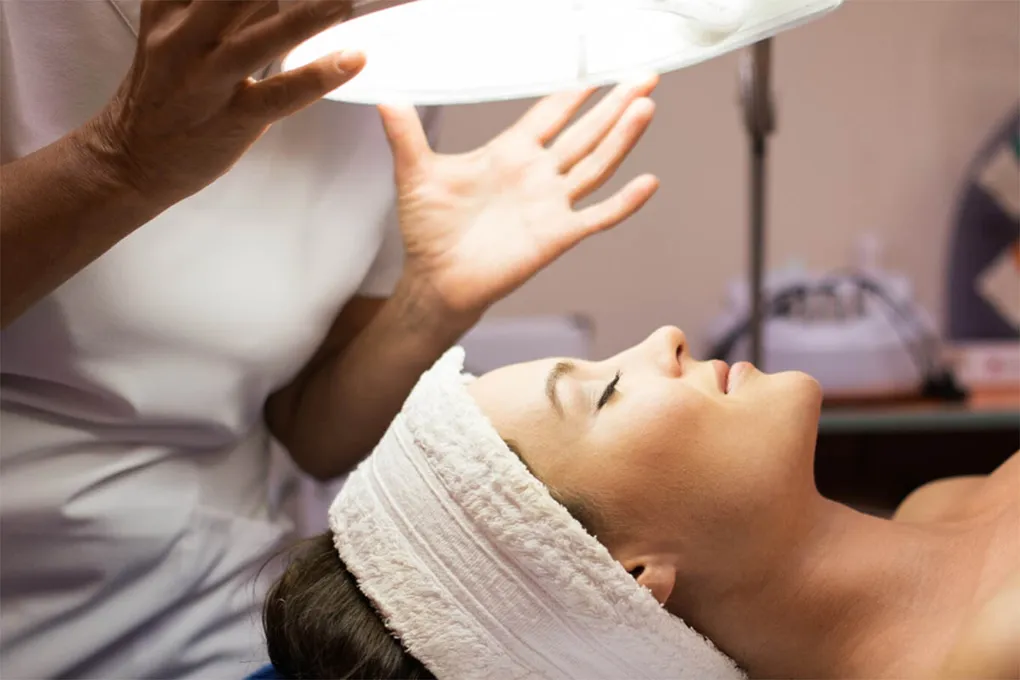
The session takes 20 to 30 minutes. The skin is cleansed and, where useful, a serum is applied. You lie under the panel with protective eyewear, the wavelengths are set for your concern, and the light runs for a timed dose. There is no heat, no sensation beyond a mild warmth from the panel, and no downtime; you can put make-up on and go straight back to work.
Courses are twice weekly for four to six weeks for acne, weekly for six weeks for rosacea and reactive skin, eight to twelve sessions for skin quality, and a single session immediately after any procedure. LED combines with almost everything: between peels for acne, after a gentle Hydrofacial for reactive skin, after microneedling and RF microneedling to speed healing, and after anti-wrinkle injections and filler to reduce bruising.
“LED is a treatment I use often and claim little for. At the right dose it calms inflamed skin, supports acne treatment and speeds healing, and it is the one thing I can do for rosacea during a flare. What it will not do is replace the treatments that change the skin, and a clinic that sells it as a facelift is selling light.”
Dr Chiké Emeagi, MRCGP, GMC 4418489
WHICH LIGHT FOR WHICH PROBLEM
Matching the wavelength to the concern
Each row is a concern with the light that suits it and what the evidence shows. The realistic-result column is what I say in the room.
| The concern | The light | What it does | When you see it | Course | Realistic result |
|---|---|---|---|---|---|
|
Inflammatory acne: red papules and pustules |
Blue 415 nm and red 633 nm |
Blue kills acne bacteria; red reduces inflammation |
2 to 4 weeks |
Twice weekly for 4 to 6 weeks |
Fewer and smaller spots; modest alone, worthwhile with skincare and peels |
|
Comedonal acne: blackheads and whiteheads |
Not LED |
Light does not clear a blocked pore |
|
|
A retinoid and salicylic acid; LED adds nothing here |
|
Rosacea, flushing and reactive skin |
Red 633 nm and near-infrared 830 nm |
Reduces inflammatory signalling without heat |
4 to 6 weeks |
Weekly for 6 |
Calmer, less reactive skin; fewer flares; vessels need IPL |
|
Redness and swelling after a procedure |
Red and near-infrared |
Accelerates repair and reduces inflammation |
Same day |
1, immediately after |
Faster settling; less bruising after injectables |
|
Fine lines and texture |
Red and near-infrared |
Stimulates fibroblasts and collagen modestly |
8 to 12 weeks |
8 to 12, twice weekly |
A subtle improvement; a support to retinoids, boosters and resurfacing |
|
Dull, tired skin |
Red and near-infrared |
Increases cellular energy and circulation |
Days |
Weekly for 4 to 6 |
A glow that lasts a couple of weeks; better maintained with skincare |
|
Wound healing and post-inflammatory marks |
Red and near-infrared |
Supports repair and reduces the inflammation that leaves marks |
Weeks |
Weekly for 6 |
Marks fade faster; pigment itself needs other treatment |
|
Home LED mask |
Varies by device |
Low-irradiance red or blue light |
Months, if at all |
Daily |
Weak evidence; some benefit from consistent use of a well-made device; not the clinic dose |
|
Pigmentation, vessels, laxity |
Not LED |
Light at these wavelengths does not reach or treat these |
|
|
IPL, peels, tightening or injectables |
The blog posts on LED for rosacea, blue versus red light and whether LED can replace anti-wrinkle injections go into the evidence.
COMBINING TREATMENTS
LED plans, and the order
LED slots between and after other treatments. On its own, it is a course.
| Plan | For whom | Order and spacing | Typical cost |
|---|---|---|---|
|
LED x8 (blue and red) |
Mild inflammatory acne, alongside skincare |
Twice weekly for 4 weeks |
£400 plus skincare |
|
Obagi Blue Radiance x3 + LED x6 |
Mild to moderate inflammatory acne |
Peel every 3 weeks; LED weekly between |
£800 |
|
Barrier routine + LED x6 |
Rosacea or reactive skin in a flare |
Routine from day one; LED weekly |
£300 plus skincare |
|
LED x6, then IPL x3 |
Rosacea: calm first, then treat the vessels |
LED weekly; IPL monthly from 8 weeks after |
£800 |
|
Microneedling x3 + LED after each |
Texture and scarring, faster healing |
Monthly; LED same day |
£690 |
|
LED after injectables |
Anyone wanting less bruising after toxin or filler |
Same day |
£50 |
|
LED x12 + retinoid |
Fine lines and texture, needle-averse |
Twice weekly for 6 weeks; retinoid nightly |
£600 plus skincare |
Costs are sums of listed clinic prices. Skincare is charged at product cost.
RESULTS
Results and what to expect
For acne, spots reduce over two to four weeks of twice-weekly sessions, and the effect is clearer when LED runs alongside a retinoid, salicylic skincare or peels than on its own. For rosacea and reactive skin, the skin feels calmer after the first two or three sessions and flares reduce across the course. After a procedure, redness and swelling settle faster on the day and bruising is less. For skin quality, a course of eight to twelve sessions produces a subtle improvement in texture and fine lines that patients notice in the mirror rather than in photographs.
The honest expectations: modest, supportive effects rather than transformation; a course rather than a session; and no effect at all on pigmentation, vessels, volume or laxity. What a well-informed patient can expect is calmer, healthier skin, faster recovery from the treatments that do the heavy lifting, and a doctor who will tell them which those are.
I photograph acne and rosacea in standard light before and after a course.
Inflammatory acne, LED with peels
Eight LED sessions alongside three peels. Photographed at 10 weeks.

Rosacea flare, LED
Six weekly sessions with a barrier routine. Photographed at 8 weeks.

Single session. Photographed at 2 weeks post treatment
AFTER THE SESSION
Recovery, side effects and aftercare
Immediately after. Nothing beyond a mild, pleasant warmth and, in some patients, a faint pinkness for an hour. Make-up and normal activity straight away.
Side effects. Rare: a headache or eye strain if the eyewear was not worn, and a temporary flare in acne in the first week as the skin responds, which settles.
Not suitable. Light-sensitising medicines, including some antibiotics and isotretinoin, photosensitive conditions such as lupus, epilepsy triggered by light, and pregnancy for blue light as a precaution. The assessment covers these.
You leave with the course dates and written advice on the skincare that makes LED worthwhile.
IS THIS FOR ME?
Is LED light therapy right for you?
LED suits almost everyone. The question is whether it is the treatment or the support.
A good candidate
Mild to moderate inflammatory acne alongside skincare. Rosacea, flushing or reactive skin, including during a flare. Anyone having peels, microneedling, laser or injectables who wants faster healing. Dull skin wanting a gentle, no-downtime course. All skin types and tones.
Better as a support to something stronger
Comedonal acne: a retinoid does the work. Fixed redness and vessels: IPL. Pigmentation: peels and skincare. Lines and laxity: injectables, boosters and resurfacing, with LED to speed recovery.
Not suitable now
Light-sensitising medicines or conditions. Isotretinoin, for the course duration. Light-triggered epilepsy. Pregnancy, for blue light, as a precaution.
PRICING
What LED light therapy costs
Every price includes the assessment, the session and protective eyewear. The £50 consultation fee is redeemed against treatment. Courses are planned at consultation.
| Treatment | What it does | Price |
|---|---|---|
|
LED light therapy, per session |
20 to 30 minutes; blue, red or near-infrared as indicated |
£50 |
|
LED added to another treatment |
Same day, after a peel, microneedling or injectables |
£50 |
|
Course of 6 |
Rosacea, reactive skin, healing |
£300 |
|
Course of 8 |
Inflammatory acne, twice weekly |
£400 |
|
Course of 12 |
Skin quality and fine lines |
£600 |
Prices are from the clinic price list. Courses are priced as multiples of the single session.
WHY US
Why choose Hampstead Aesthetics for LED
LED is sold as a standalone anti-ageing treatment by clinics with a panel and no other tools, and as a cure for everything by companies selling masks. I am a Member of the Royal College of General Practitioners and a GMC-registered doctor (4418489); the LED here is a medical-grade panel delivering a measured dose, used where the evidence supports it, inside plans that include the prescription skincare, peels and other treatments that do most of the work, and described in the terms the trials justify.
Every assessment is mine and every session is carried out or supervised by me. The clinic is on West End Lane in West Hampstead, NW6, two minutes from West Hampstead station, and sees patients from Swiss Cottage, St John’s Wood, Belsize Park, Primrose Hill and across North London.
HOME CARE
What makes LED worthwhile
For acne, a retinoid at night and a salicylic cleanser in the morning, through the prescription retinoid programme or ZO Skin Health, because LED reduces inflammation and the retinoid stops the pores blocking; one without the other is half a treatment. For rosacea, a cream cleanser, a ceramide moisturiser and a mineral SPF, with the triggers identified and avoided. For skin quality, a retinoid and daily SPF, which do more for lines over a year than any course of light. If you own a home LED mask, use it daily rather than occasionally, keep it close to the skin, and treat it as a supplement to the clinic course rather than a substitute; a well-made device used consistently does something, and an occasional session does nothing.
PATIENT REVIEWS
What patients say
Google 4.8 ★★★★★
TRUSTED BRANDS
Clinically validated products we use
The clinic uses a medical-grade, CE-marked LED panel delivering blue, red and near-infrared wavelengths at a measured irradiance. Prescription skincare is dispensed through a registered UK pharmacy.


WHO IS YOUR PRACTITIONER
Medical Governance & Practitioner Verification

Dr Chike Emeagi - GMC Registration No. 4418489
At Hampstead Aesthetics, every LED course is assessed by Dr Chike Emeagi, a fully registered medical doctor and GP whose qualifications and licence to practise are publicly verifiable.
MRCGP - Member of the Royal College of General Practitioners
MRCS - Member of the Royal College of Surgeons of Edinburgh
MSc Aesthetic Medicine - Postgraduate master's degree in aesthetic clinical practice
GMC Licensed - Full licence to practise, verifiable on the public medical register
You are encouraged to verify Dr Chike’s registration directly on the https://www.gmc-uk.org/
DOCTOR LED TREATMENT
Why Doctor Led Matters
LED is safe, and its risk is not the light but the diagnosis it replaces: acne that needs prescription treatment given light instead, rosacea mistaken for acne, or a pigmented lesion under a panel that should have been under a dermatoscope. The value of a medical setting is that LED is prescribed as part of a plan by someone who can also prescribe the rest of it.
At Hampstead Aesthetics I assess the skin, decide whether LED is the treatment or the support, prescribe the skincare that makes it worthwhile, and carry out or supervise every session.
YOUR SAFETY
Emergency Safety Protocols
- Anaphylaxis kit on site — full adrenaline protocol for allergic reaction.
- ACE-certified practitioner — I hold emergency complication management certification.
- 999 escalation protocol — written procedures for emergency hospital transfer.
Every product and device is CE-marked and sourced from authorised UK distributors. The clinic holds full professional indemnity insurance covering all treatments.
CONSENT
Consent, Privacy & Your Rights
Before treatment you have a full written consultation covering medical history, contraindications, realistic outcomes and the specific risks of each treatment in your plan. Treatment only proceeds with informed, documented consent. If you have a concern, raise it with me directly; if it is not resolved, you can escalate to the General Medical Council.
Your consultation, treatment and review are all conducted by the same doctor. There are no hand-offs.
Reviewed September 2026. Dr Chike Emeagi, GMC No. 4418489. Regulatory position correct at date of review; licensing of non-surgical cosmetic procedures in England is subject to change.
FAQ's
Frequently Asked Questions
Does LED light therapy actually work?
For inflammatory acne, rosacea and reactive skin, and healing after procedures, yes, at a clinic dose and as a course, and the effect is modest and supportive rather than transforming. For fine lines and texture the effect is small and gradual. For pigmentation, vessels, volume and laxity it does nothing. The trials support the first group, and I offer it for those.
What is the difference between blue and red LED light?
Blue light, at around 415 nanometres, is absorbed by the bacteria in acne and kills them; it acts at the surface and is for inflammatory spots. Red light, at around 633 nanometres, and near-infrared, at around 830, reach the dermis, increase cellular energy, reduce inflammation and stimulate collagen; they are for rosacea, healing and skin quality. Acne usually gets both. My blog on blue versus red light goes into the detail.
Is LED good for acne?
For red, inflamed spots, as a support: blue and red light twice weekly for four to six weeks reduce the bacteria and the inflammation, and alongside a retinoid, salicylic skincare and peels the improvement is worthwhile. On its own the effect is modest, it does nothing for blackheads, and nodular or cystic acne needs prescription treatment. My acne page explains the grading.
Does LED help rosacea?
Yes, and it is the one in-clinic treatment I use during a flare, because it calms inflammation without heat. Red and near-infrared light weekly for six weeks reduce reactivity and the frequency of flares. It does not close the vessels that hold fixed redness, which need IPL once the skin is calm. My blog on LED for rosacea explains how it fits.
Do LED face masks work?
Some do something, if they deliver a reasonable irradiance at a useful wavelength and are used daily and close to the skin. Most deliver a fraction of the clinic dose, and the evidence for home devices is far weaker than for clinic panels. A well-made mask used consistently is a reasonable supplement for rosacea-prone or acne-prone skin; it is not a substitute for a course at the clinic dose, and it is not a treatment for lines, pigment or laxity whatever the advertising says.
Can LED replace anti-wrinkle injections?
No. LED stimulates collagen modestly and improves texture a little over a course; it does not relax the muscles that fold the skin into lines, which is what anti-wrinkle injections do. The two address different things and combine well. My blog on whether LED can replace anti-wrinkle injections sets out the evidence.
How many LED sessions do I need?
Acne: twice weekly for four to six weeks. Rosacea and reactive skin: weekly for six. Skin quality: eight to twelve sessions over six weeks. Healing after a procedure: one session immediately after. A single session is pleasant and does little; the effect is cumulative.
Is there any downtime?
None. There is no heat, no peeling and no redness beyond a faint pinkness for an hour in some patients. Make-up goes on straight after and you return to your day. It is the one treatment in the clinic with no recovery at all.
Is LED safe for darker skin?
Yes. LED at these wavelengths is absorbed by bacteria and by mitochondria, not by melanin, so there is no heating of pigment and no risk of the pigment change that IPL and laser carry in darker skin. It is used across all skin types.
Is LED light therapy safe?
Yes, with protective eyewear and the exclusions the assessment covers: light-sensitising medicines such as some antibiotics and isotretinoin, photosensitive conditions such as lupus, and light-triggered epilepsy. It does not contain ultraviolet and does not damage the skin. Blue light is avoided in pregnancy as a precaution.
Can I have LED with other treatments?
It combines with almost everything and is usually better as a combination: between peels for acne, after microneedling, RF microneedling and laser to speed healing, after injectables to reduce bruising, and alongside a barrier routine for rosacea. It is added to another treatment on the same day for £50.
How much does LED light therapy cost?
At Hampstead Aesthetics LED is £50 a session, whether on its own or added to another treatment. A course of six is £300, eight is £400 and twelve is £600. The £50 consultation fee is redeemed against treatment.
Where in London do you offer LED light therapy?
At Hampstead Aesthetics on West End Lane, West Hampstead, NW6, two minutes from West Hampstead Overground, Thameslink and Jubilee line stations. Patients come from Hampstead, Swiss Cottage, St John’s Wood, Belsize Park, Kilburn, Primrose Hill and across North London.
Arrange your LED consultation
If your skin is inflamed, reactive or breaking out, or you want faster healing after a treatment, a 15-minute assessment tells you whether LED will help, which wavelengths, how many sessions, and what should run alongside it. Patients come from West Hampstead, NW6 and across North London. Related: Acne, Rosacea and redness, Dry and sensitive skin, Fine lines and wrinkles.
VISIT US
Our London Clinic
Nearest Tube: West Hampstead (Jubilee Line) · 2 min walk
Overground: West Hampstead Overground · 3 min walk
Parking: Pay & Display on West End Lane
Proudly serving clients from:
West Hampstead · Hampstead · Primrose Hill · St John’s Wood · Belsize Park · Camden · Swiss Cottage · Finchley Road · Maida Vale · Queen’s Park · Highgate · Kentish Town
- Hampstead Aesthetics West Hampstead, London NW6
- Call us 020 3196 7222
- WhatsApp 07869 730 159
- Email: info@hampsteadaesthetics.com
- Opening hours: Mon–Fri 9am–7pm, Sat 10am–5pm, Sunday closed
Reviewed by Dr Chiké Emeagi, MBBS, MRCGP, MRCS, GMC No. 4418489.
Last reviewed September 2026. This page is for information only and does not replace a medical consultation. Results vary between individuals and are not guaranteed. All treatments carry potential risks, which are discussed before any procedure. Prescription-only medicines are not advertised on this page. Prices are taken from the clinic price list at the date of review. Hampstead Aesthetics, 269 West End Lane, West Hampstead, London NW6 1QS.
Book Your Consultation